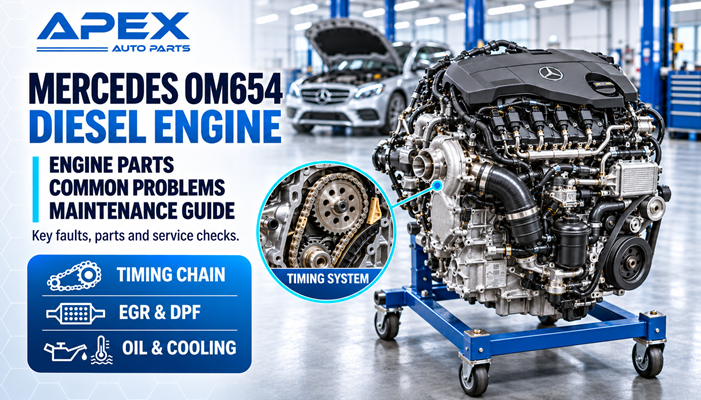
Designed to reduce weight, improve fuel efficiency and meet increasingly demanding emissions standards, the OM654 combines modern engine technology with a compact design. It has been used in Mercedes-Benz passenger cars and commercial vehicles, including selected C-Class, E-Class, GLC, Vito and Sprinter models.
However, like any modern diesel engine, the OM654 depends on correct servicing, suitable replacement parts, and properly functioning emissions-control systems. Problems involving the EGR system, diesel particulate filter, AdBlue equipment, injectors, and lubrication can lead to unexpected repair costs.
Whether you already own an OM654-powered Mercedes or are considering buying one, understanding its components, common problems, and maintenance requirements can help you make informed decisions.
What Is the Mercedes-Benz OM654 Engine?
The Mercedes-Benz OM654 is a family of turbocharged, four-cylinder diesel engines introduced in 2016. Its original 1,950 cc version was developed to replace the 2.1-litre OM651 in selected applications.
One of the engine’s defining features is its lightweight aluminium crankcase combined with steel pistons and a specialised NANOSLIDE cylinder surface coating. This design reduces friction between the pistons and cylinder walls while helping the engine deliver efficient performance.
The OM654 also incorporates common-rail fuel injection, turbocharging and sophisticated exhaust after-treatment equipment.
Depending on the model and generation, the engine may use different turbocharger arrangements, injection components, and emissions systems. Later OM654M versions introduced further developments, including a 1,993 cc configuration in certain applications and mild-hybrid assistance in selected vehicles.
These differences matter when diagnosing faults or ordering replacement parts. Two Mercedes vehicles carrying similar model badges may use different OM654 configurations.
Mercedes OM654 Engine Technical Specifications
The following table outlines the general characteristics of the original OM654 and selected later versions.
| Specification | OM654 |
| Engine type | Turbocharged diesel |
| Cylinder configuration | Inline four-cylinder |
| Original displacement | 1,950 cc |
| Later displacement | 1,993 cc in selected OM654M versions |
| Cylinder block | Aluminium |
| Cylinder surface technology | NANOSLIDE coating |
| Fuel delivery | Common-rail direct injection |
| Induction | Turbocharged; configuration varies by version. |
| Emissions equipment | May include EGR, DPF, and SCR/AdBlue systems |
| Power output | Varies by engine and vehicle specification |
For example, Mercedes-Benz offered an OM654-powered E 220 d producing approximately 194 PS and 400 Nm in a particular specification. Other versions have different power and torque figures. These numbers should not be treated as universal OM654 specifications.
The engine’s combination of strong torque, reduced internal friction, and modern emissions technology makes it suitable for a wide range of passenger cars and commercial vehicles.
Which Mercedes-Benz Models Use the OM654 Engine?
The OM654 family has been installed in various Mercedes-Benz models, depending on the market, production year, and engine variant.
Examples include:
- Mercedes-Benz C-Class: Selected C 200d and C 220d variants.
- Mercedes-Benz E-Class: Selected E 200 d, E 220 d, and other diesel versions.
- Mercedes-Benz GLC: Selected 2.0-litre diesel models.
- Mercedes-Benz CLS: Selected four-cylinder diesel versions.
- Mercedes-Benz Vito: Selected commercial and passenger-carrying variants.
- Mercedes-Benz V-Class: Selected diesel configurations.
- Mercedes-Benz Sprinter: Selected newer diesel variants.
Not every vehicle listed uses the same OM654 version, and some model years use other engine families.
Before buying replacement components, confirm the engine code, production date, VIN, and original part number. This is particularly important for turbochargers, injectors, sensors, timing components, and emissions-system parts.
Essential Mercedes OM654 Engine Parts
Understanding the main engine components makes it easier to recognise common faults and select suitable replacement parts.
1. Timing Chain and Timing Components
The timing system synchronises the crankshaft and camshafts, ensuring that the engine’s valves operate at the right moments.
Its components may include the timing chain, guides, tensioning mechanism, sprockets and associated seals or fasteners.
Although the OM654 should not automatically be associated with the same timing-chain problems as its predecessor, the OM651, timing components can still wear or develop faults.
Unusual rattling, particularly during a cold start, should be investigated rather than ignored.
2. Fuel Injectors and High-Pressure Fuel System
The OM654 uses common-rail direct fuel injection to deliver diesel at high pressure.
The system includes injectors, a high-pressure fuel pump, a common rail, and pressure-control components. These parts must operate accurately to maintain combustion quality and fuel efficiency.
Faulty injectors or fuel pressure problems can cause difficult starting, rough running, reduced power, and increased fuel consumption.
Replacement injectors must match the exact engine specification, and installation may require specialist procedures and injector coding.
3. Turbocharger and Boost System
The turbocharger increases the amount of air entering the engine, helping it produce strong torque without requiring a larger displacement.
Depending on the engine version, the turbocharging system may include a variable-geometry mechanism, actuators, boost hoses and an intercooler.
A damaged turbocharger or leaking boost connection can result in sluggish acceleration, unusual noises, excessive smoke or reduced engine power.
Before replacing a turbocharger, the workshop should check the associated air, oil and boost systems to identify the underlying cause.
4. EGR Valve and EGR Cooler
The exhaust gas recirculation system returns a controlled quantity of exhaust gas to the engine to reduce nitrogen oxide emissions.
The EGR valve regulates this flow, while the cooler lowers the temperature of the recirculated gases.
Carbon deposits, mechanical faults, and coolant leaks can affect these components.
An EGR fault may cause warning lights, poor performance, or emissions-related problems. A leaking cooler can also contribute to unexplained coolant loss and requires prompt investigation.
5. Diesel Particulate Filter (DPF)
The DPF captures soot from exhaust gases and periodically burns off accumulated particles through regeneration.
Its performance depends on suitable operating conditions and a properly functioning engine management system.
Excessive soot accumulation, failed regeneration, or faulty sensors can cause DPF warnings and reduced performance.
Repeated regeneration problems should be diagnosed rather than addressed through repeated cleaning attempts without identifying the cause.
6. AdBlue and SCR Components
Many OM654-powered vehicles use selective catalytic reduction (SCR) technology to reduce nitrogen oxide emissions.
Depending on the application, the system includes an AdBlue tank, pump, delivery components, injector, and NOx sensors.
A fault in one of these components can trigger an emissions warning or a message indicating that the vehicle may not restart after a specified limit.
The exact equipment varies by model. Replacement parts must be matched to the vehicle’s emissions specification.
7. Oil Filter, Oil Pump and Lubrication Components
The lubrication system supplies engine oil to moving components and helps control friction and heat.
The oil filter removes contaminants, while the oil pump maintains the required oil circulation and pressure.
Incorrect oil, delayed servicing, or contamination can compromise lubrication and contribute to premature wear.
Oil filters and engine oil must meet the manufacturer’s requirements for the exact vehicle. Selecting parts solely because they physically fit is not sufficient.
Common Mercedes OM654 Engine Problems
1. EGR System Faults
The EGR system operates under demanding thermal conditions and can accumulate deposits over time.
A malfunctioning valve or restricted flow may affect combustion and emissions performance.
Common symptoms include:
- Engine management warning lights.
- Reduced acceleration.
- Uneven engine running.
- Increased fuel consumption.
- Emissions-related diagnostic fault codes.
These symptoms are not exclusive to EGR faults. Problems with airflow sensors, boost pressure, injectors, or other emissions components can produce similar behaviour.
A diagnostic scan and inspection can establish whether the valve, cooler, wiring, or another component is responsible.
2. DPF Blockages and Regeneration Problems
Diesel engines that spend most of their time on short journeys may struggle to complete DPF regeneration under suitable conditions.
When regeneration is repeatedly interrupted, soot can accumulate and restrict exhaust flow.
Possible warning signs include a DPF warning light, reduced engine power, increased fuel consumption, and the engine entering limp mode.
The DPF is not always the original cause of the problem. Faulty temperature sensors, pressure sensors, EGR components, or other engine issues can prevent regeneration from completing properly.
Follow the vehicle handbook when a DPF warning appears. If the warning persists, arrange professional diagnosis instead of assuming that a longer drive will solve every problem.
3. AdBlue and NOx Sensor Faults
Modern diesel emissions systems rely on sensors and fluid-delivery components to operate within the required parameters.
Faults involving NOx sensors, AdBlue delivery, or SCR components can trigger warning messages even when the engine itself continues to run normally.
Drivers may experience emissions warnings, reduced performance, or a no-restart countdown.
Use the correct AdBlue fluid and follow the manufacturer’s instructions. If the warning remains after topping up, further diagnosis may be required.
Because several components can produce similar symptoms, replacing a NOx sensor or pump without testing the system may lead to unnecessary expense.
4. Injector Seals and Fuel System Leaks
Injectors operate under high pressure and must seal correctly against the cylinder head.
If an injector seal leaks, combustion gases may escape around the injector and create deposits in the surrounding area. Affected diesel engines can develop a characteristic chuffing sound, unusual odour, or visible contamination.
However, injector-related problems should not be assumed to affect every OM654 engine.
If leakage is suspected, a specialist should inspect the injector seating area and assess the fuel system. Repair procedures may require new seals, suitable fasteners, and correct injector installation.
High-pressure diesel fuel systems should only be handled by suitably trained technicians.
5. Timing Chain Noise or Wear
Although the OM654’s design differs from the earlier OM651, timing-chain wear remains a possible concern as engines age.
A rattling sound during starting, persistent mechanical noise, or timing-related fault codes warrant investigation.
However, noises from auxiliary components, fuel injection, and other engine systems can sometimes be mistaken for timing-chain problems.
A proper diagnosis should establish the source of the noise before timing components are replaced.
If the engine develops loud or persistent mechanical rattling, stop driving when safe and arrange an inspection to reduce the risk of further damage.
6. Oil Sludge and Internal Engine Wear
Engine oil can deteriorate or become contaminated if servicing is delayed, the wrong fluid is used, or other operating problems occur.
Sludge can restrict oil circulation and contribute to wear in components such as bearings and camshaft-related parts.
Mercedes-Benz has published technical service information covering internal diesel engine damage and oil sludge in certain Sprinter 907 vehicles equipped with OM654, OM642 or OM651 engines.
The guidance identifies overdue maintenance, unsuitable parts or fluids, and contamination as contributing factors. This is specific technical guidance for the vehicles and circumstances covered by the document, not evidence that every OM654 engine is affected.
Possible warning signs include the following:
- Difficulty starting.
- Unusual internal engine noises.
- An oil pressure warning.
- Evidence of heavily degraded oil.
- Rough operation or reduced performance.
An oil pressure warning while the engine is running requires immediate attention. Stop the engine as soon as it is safe to do so and seek professional assistance.
If internal wear or sludge is suspected, simply changing the oil may not be enough. The lubrication system and affected mechanical components may need to be inspected.
7. Turbocharger and Boost Leaks
Turbocharger problems can arise from wear, lubrication issues, damaged hoses, or faults in the boost-control system.
Common symptoms include reduced power, unusual whining, smoke, and poor acceleration.
However, a loss of boost does not automatically indicate turbocharger failure. A split hose, faulty actuator, or sensor problem can produce similar symptoms.
Diagnosis should include inspection of the boost system, relevant pressure readings, and the turbocharger’s oil supply where appropriate.
Using the correct engine oil and following the specified service schedule can help protect the turbocharger and other lubricated components.
8. Coolant Leaks and Temperature Problems
The cooling system regulates engine temperature and protects the engine from excessive heat.
Coolant leaks can develop in hoses, connections, seals, and other cooling components. The precise failure points depend on the vehicle and engine configuration.
Warning signs include falling coolant levels, visible leaks, temperature warnings, or unexplained overheating.
Repeated coolant loss should be investigated rather than managed indefinitely through topping up.
Never open a hot, pressurised cooling system. If the engine overheats, stop as soon as it is safe, switch it off and arrange assistance.
Mercedes OM654 Maintenance Guide
Regular maintenance is particularly important for a modern diesel engine with turbocharging and complex emissions equipment.
1. Use the Correct Engine Oil
Always select engine oil with the Mercedes-Benz approval required for the exact vehicle and engine variant.
Depending on the application, OM654-compatible approvals can include MB 229.51, MB 229.52 and other specified approvals. The correct choice depends on the model, operating conditions, and applicable maintenance documentation.
Mercedes-Benz’s published Sprinter guidance, for example, lists several approved oil specifications for OM654 applications. It also stresses the importance of using the appropriate viscosity and approved oil for the vehicle.
Do not choose oil solely on the basis of viscosity or a generic recommendation for all Mercedes diesel engines.
2. Follow the Specified Service Intervals
Follow the maintenance schedule displayed by the vehicle or provided in its service documentation.
If the vehicle regularly operates under demanding conditions, discuss the suitability of a shorter oil service interval with a Mercedes-Benz specialist.
Always replace the oil filter when required and ensure that the correct filter is fitted.
3. Monitor Oil and Coolant Levels
Check fluid levels according to the owner’s manual and investigate unexpected changes.
Falling coolant levels may indicate a leak, while unusual oil conditions or pressure warnings can indicate a lubrication problem.
Never add AdBlue, coolant, or washer fluid to the engine oil filler. These fluids are not substitutes for engine oil and can cause severe damage if mixed with the lubrication system.
4. Maintain the DPF and EGR Systems
Follow the manufacturer’s guidance on DPF warnings and regeneration.
Where practical, use the vehicle in conditions that allow the engine to reach normal operating temperature. However, repeated warnings or failed regeneration should be investigated rather than treated as a driving-habit issue alone.
Do not remove or disable emissions-control equipment as a substitute for repairing a fault.
5. Inspect the Turbocharger and Intake System
During routine servicing, have relevant hoses, connections and intake components checked when symptoms or service requirements indicate it is necessary.
Investigate new whining noises, unusual smoke or loss of boost promptly.
6. Check for Recalls and Technical Campaigns
Recall applicability depends on the vehicle’s VIN, production date and specification.
Ask an authorised Mercedes-Benz dealer to check for outstanding recalls or applicable service campaigns. Do not assume that a reported problem applies to every OM654 vehicle.
7. Use Correct Replacement Parts
Replacement parts should match the exact engine and vehicle specification.
Check compatibility using the VIN, engine code, and original part number wherever possible. This is particularly important for injectors, sensors, timing components, oil filters, and emissions equipment.
Correct installation matters just as much as selecting the right part.
Is the Mercedes OM654 Engine Reliable?
The OM654 offers several engineering advantages, including reduced weight, low-friction cylinder technology, and modern emissions management.
It can provide strong torque, refined operation, and good fuel efficiency when properly maintained. However, reliability depends on the exact engine version, service history, driving conditions, and the condition of its supporting systems.
Some owners may encounter emissions-related faults, coolant leaks, or component wear, while poorly maintained engines can suffer more serious lubrication problems.
The most useful way to assess an OM654-powered vehicle is to review its maintenance history, check for outstanding recalls, and investigate any warning signs before they become major repairs.
Buying a Used Mercedes With an OM654 Engine
A used Mercedes equipped with the OM654 can be a sensible choice, but the inspection should go beyond mileage and exterior condition.
Before buying, consider these checks:
- Verify the engine specification: Confirm the engine code and production date.
- Review service records: Look for regular servicing and evidence that the correct oil and filters were used.
- Listen to a cold start: Investigate unusual rattling, knocking, or persistent mechanical noise.
- Check the emissions system: Look for DPF, EGR, AdBlue, and NOx sensor warnings.
- Inspect for leaks: Check for signs of oil or coolant loss.
- Review diagnostic information: Have stored fault codes assessed by a qualified technician.
- Confirm recall status: Ask a Mercedes-Benz dealer to check the VIN.
- Arrange an independent inspection: A specialist can assess the engine and identify issues that may not appear during a short test drive.
A vehicle with a documented maintenance history and correctly completed repairs may be a better purchase than one with lower mileage but uncertain servicing.
When Should You Seek Professional Help?
Some symptoms require more urgent attention than others.
Arrange an inspection if you notice repeated emissions warnings, unexplained coolant loss, unusual timing-related noise, or a persistent drop in engine performance.
Stop driving when safe and seek professional assistance if the engine develops severe knocking, loses oil pressure, overheats, or produces heavy smoke.
The correct response depends on the fault, but continuing to operate an engine with a serious lubrication or cooling problem can cause substantial additional damage.
Final Thoughts
The Mercedes-Benz OM654 is an important modern diesel engine designed to combine performance, efficiency and reduced emissions.
Its lightweight construction, low-friction cylinder coating and advanced fuel and emissions systems offer clear engineering benefits. Nevertheless, the engine relies on correct servicing and properly functioning components to deliver dependable long-term performance.
Owners should pay particular attention to oil quality, service intervals, EGR and DPF operation, AdBlue warnings, coolant levels and unusual mechanical noises.
When repairs are required, accurate diagnosis and correctly matched replacement parts are essential. Replacing a component without addressing the underlying cause can lead to recurring problems and unnecessary costs.
Whether you own a Mercedes passenger car or a commercial vehicle fitted with the OM654, understanding its components and following the correct maintenance procedures can help protect the engine and keep the vehicle operating reliably.