
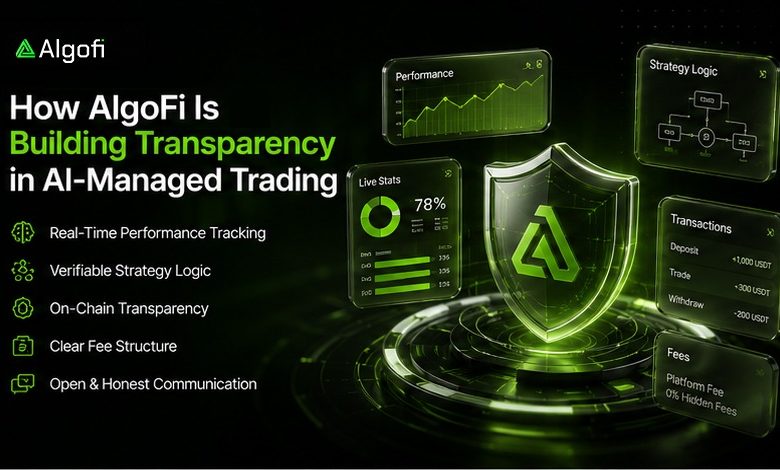
“AI-managed trading” is often described in marketing terms that leave out exactly what the AI does, who holds the funds, and what happens when a strategy underperforms. That gap between marketing language and operating reality is where trust in the entire category has been damaged.
AlgoFi’s approach to transparency is not a single feature — it’s a set of disclosures across custody, strategy structure, risk management, and redemption mechanics that are made explicit rather than left implied.
Transparency in AI-managed trading means disclosing what a system actually does and doesn’t do — not simply publishing a return figure and calling it proof of trustworthiness.
This article walks through the specific areas where AlgoFi discloses its mechanics, and why each of those disclosures matters to someone evaluating the platform.
Key Takeaways
● Transparency at AlgoFi spans five areas: custody, redemption mechanics, strategy structure, risk framework, and performance limitations.
● AlgoFi discloses that it is wallet-connected but not fully non-custodial, rather than allowing a wallet-connection screen to imply full self-custody.
● The seven-day cooling period and the separation between redemption and withdrawal are stated explicitly, not buried in terms of service.
● AlgoFi names its six strategies — Tenzor, Nuvex, Drav, Yark, Xylo, and Omnix — rather than describing itself as one undisclosed algorithm.
● Risk controls are disclosed as a distinct layer from signal generation, clarifying that automation governs position sizing and exposure, not just trade selection.
● Transparency does not mean reduced risk — disclosing mechanics clearly does not change the fact that AlgoFi’s strategies can lose money.
Why Transparency Matters More in AI-Managed Trading
Automated and AI-assisted trading systems are often trusted based on how sophisticated they sound rather than how clearly they explain their own mechanics. That’s a risk in itself — a well-marketed system that discloses little is not inherently more trustworthy than a plainly described one.
A system that clearly explains what it does, where funds go, and what its limitations are gives users the information needed to make an informed decision — it does not, by itself, make the underlying trading safer.
The sections below cover the specific areas where that kind of disclosure applies at AlgoFi.
Transparency Around Custody
AlgoFi is a wallet-connected platform, but wallet-connected does not mean allocated funds remain continuously inside a user’s personal wallet.
Once supported assets are deposited and allocated to a strategy, they enter AlgoFi’s managed trading environment and may be deployed through its operational infrastructure and approved third-party providers. This is stated directly rather than left for a user to assume based on the presence of a wallet-connect button.
● What’s disclosed: the wallet is an access and onboarding point, not a guarantee that funds stay in it
● What’s disclosed: funds enter a managed environment once allocated to a strategy
● Why it matters: prevents users from confusing wallet-connected with fully non-custodial
Transparency Around Redemption and Withdrawal
Exiting a strategy and withdrawing funds to an external wallet are two separate, disclosed steps — not one action.
A redemption request is currently subject to a seven-day cooling period. After that period completes, funds move to Available Balance, from which a separate withdrawal request can be submitted. Stating this sequence explicitly — rather than implying instant access — is part of setting accurate expectations before capital is allocated.
● What’s disclosed: the exact length of the cooling period
● What’s disclosed: that redemption and withdrawal are distinct steps
● Why it matters: liquidity expectations should be set before allocating, not discovered during an exit
Transparency Around Strategy Structure
AlgoFi names its six strategies rather than describing itself as a single undisclosed algorithm.
Tenzor, Nuvex, Drav, Yark, Xylo, and Omnix are each built around differentiated methodologies. Naming and differentiating them allows a user to evaluate the specific approach they’re allocating to, rather than trusting a generic claim that “AI manages your money.”
● What’s disclosed: the number and names of available strategies
● What’s disclosed: that each strategy uses a differentiated methodology
● Why it matters: users can evaluate methodology and risk instead of relying on a black-box claim
Transparency Around Risk Management
AlgoFi discloses that risk management operates as a layer separate from signal generation, rather than presenting risk control as an unspecified part of “the algorithm.”
Identifying a trading opportunity and deciding how much capital to risk on it are treated and described as two distinct processes. Making that separation explicit clarifies what automation is actually doing at each stage, rather than leaving “risk management” as a vague reassurance.
● What’s disclosed: risk controls are applied consistently regardless of recent performance
● What’s disclosed: risk controls manage the size of potential losses, not whether losses occur
● Why it matters: distinguishes real risk architecture from a marketing claim
Transparency Around Performance Limitations
AlgoFi states directly that past, backtested, or simulated performance does not guarantee future results, for any individual strategy or the platform as a whole.
This kind of disclosure is easy to bury in fine print. Making it a stated part of how AlgoFi describes itself — rather than only appearing in a footer disclaimer — is part of treating transparency as a design principle, not a compliance formality.
AlgoFi’s Transparency Disclosures at a Glance
| Transparency Area | What AlgoFi Discloses | Why It Matters |
| Custody model | Wallet-connected but not fully non-custodial; funds enter a managed trading environment once allocated | Prevents users from assuming funds stay in their wallet while a strategy is active |
| Redemption process | Seven-day cooling period on redemption, separate from the withdrawal step | Sets accurate expectations for how quickly funds can actually be accessed |
| Strategy structure | Six named, differentiated strategies (Tenzor, Nuvex, Drav, Yark, Xylo, Omnix) rather than one undisclosed algorithm | Lets users evaluate methodology and risk rather than trusting a black box |
| Risk framework | Risk controls disclosed as a separate layer from signal generation | Clarifies that automation manages position sizing, not just trade selection |
| Performance limits | Explicit statements that past, backtested, or simulated results do not guarantee future performance | Counters the common assumption that automation implies predictable returns |
Does Transparency Mean AlgoFi Is Safer?
Not automatically, and this distinction matters.
Disclosing mechanics clearly does not reduce market risk — it reduces the risk of misunderstanding how the platform works.
A strategy can be described with complete transparency and still lose money, experience a drawdown, or underperform. Transparency changes what a user understands before allocating capital; it does not change what happens to that capital once markets move against a strategy’s methodology.
The relevant question is not “is this platform transparent?” alone — it’s “does that transparency give me an accurate picture of the risk I’m taking?”
What to Look for When Evaluating an AI-Managed Platform’s Transparency
Does it explain where your funds actually go?
A vague reference to “secure custody” is different from a stated explanation of the deposit-to-allocation flow.
Does it name its strategies or methodologies?
Generic claims like “proprietary AI” without any further detail make it difficult to evaluate what’s actually happening.
Does it state exact timelines for redemption and withdrawal?
“Fast withdrawals” is not the same as a stated number of days.
Does it separate risk management from trade signals in its own description?
If risk management is only described as part of “the algorithm,” it’s harder to evaluate independently.
Does it clearly state that past performance doesn’t guarantee future results?
Platforms that lead with returns and bury this disclosure are describing themselves differently than platforms that state it upfront.
Frequently Asked Questions
What does transparency mean in AI-managed trading?
Transparency in AI-managed trading means clearly disclosing what a platform’s automation actually does, where user funds are held, how risk is managed, and what performance limitations apply, rather than relying on general claims about AI or automation.
Is AlgoFi transparent about where my funds are held?
Yes. AlgoFi discloses that it is wallet-connected but not fully non-custodial, and that funds enter its managed trading environment once allocated to a strategy.
Does AlgoFi disclose its trading strategies?
Yes. AlgoFi names its six strategies — Tenzor, Nuvex, Drav, Yark, Xylo, and Omnix — rather than describing its trading approach as a single undisclosed algorithm.
How transparent is AlgoFi about withdrawal timelines?
AlgoFi states a specific seven-day cooling period for redemption, separate from the subsequent withdrawal request, rather than describing withdrawals only in general terms.
Does transparency mean AlgoFi’s strategies are less risky?
No. Transparency means AlgoFi’s mechanics are clearly disclosed; it does not reduce the market risk inherent in any of its systematic strategies, which can still experience losses.
How does AlgoFi disclose its risk management approach?
AlgoFi describes risk management as a layer separate from signal generation, applying position sizing and risk parameters consistently rather than folding risk control into a vague description of “the algorithm.”
Does AlgoFi guarantee its disclosed strategies will perform well?
No. AlgoFi states directly that past, backtested, or simulated performance does not guarantee future results for any strategy.
The Bottom Line
Transparency in AI-managed trading means disclosing custody structure, strategy methodology, risk architecture, redemption timelines, and performance limitations clearly — not simply publishing a return figure.
AlgoFi’s approach spans each of those areas: naming its six strategies, stating its cooling period explicitly, separating risk management from signal generation in its own description, and being direct about the limits of past performance.
None of that transparency removes market risk. The most useful question when evaluating any AI-managed platform isn’t how advanced it sounds — it’s whether its disclosures give you an accurate picture of what happens to your funds and what risk you’re actually taking.