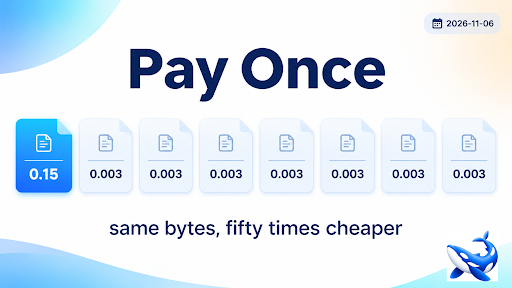
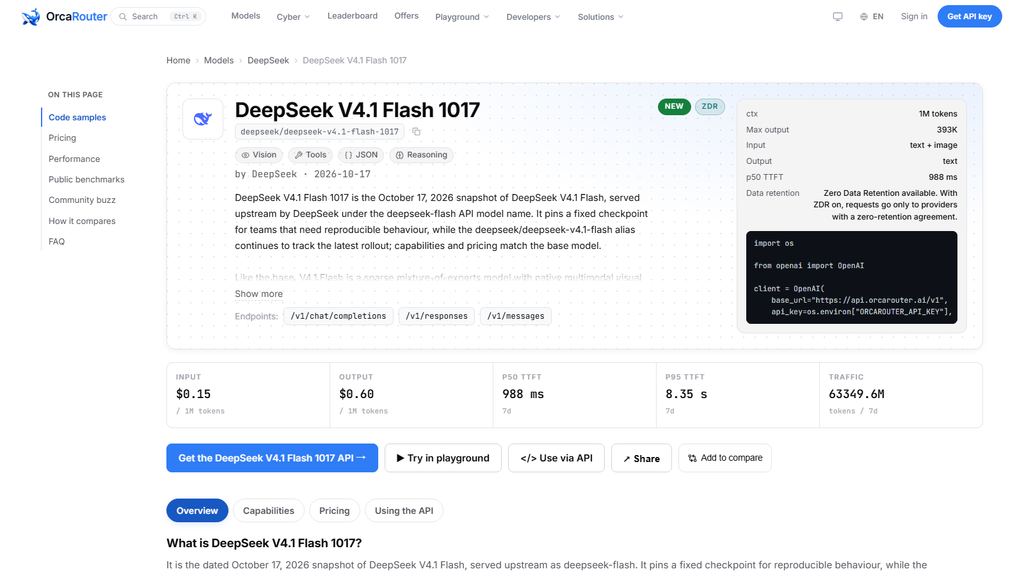
On OrcaRouter the cheapest line on the price card is the one that decides the bill. Most of the tokens in a long conversation are the same tokens as last time. That is obvious, and the price of that repetition is where cards differ enormously. DeepSeek V4.1 Flash 1017 pricing on OrcaRouter is $0.15 in, $0.60 out, and $0.003 for a cache read — a cached token costs two percent of a fresh one, a fifty-fold discount, the largest in the catalogue.
For a workload that holds a document and asks questions about it, that ratio does more than any model choice. It converts the large part of the bill — the repeated context — from a per-request cost into a near-fixed one.
The same workload, priced two ways
Take a 120,000-token contract set and fifteen questions about it, each with a 500-token prompt and a 1,500-token answer.
Without a cache, every question re-sends the 120,000 tokens: 1.8 million input tokens at $0.15 is $0.27, plus fifteen answers of 1,500 tokens at $0.60 — 22,500 tokens, $0.0135. Total $0.2835 [OURS].
With a cache hit on the repeated block, the first send costs $0.018, and the fourteen repeats cost 1.68 million tokens at $0.003 — $0.005. Output is unchanged at $0.0135. Total $0.037.
The saving is $0.247 on a single session, a reduction of 87% [OURS]. The cache is not a discount on the bill; it is a different bill, one where the context is paid for once and the questions are cheap.
Why the ratio matters more than the rate
Two cards can have the same headline rate and wildly different repetition costs. The wide range across this catalogue is worth knowing:
| card | input | cache | cache as % of input |
| DeepSeek V4.1 Flash 1017 | $0.15 | $0.003 | 2.0% |
| OrcaCyber Flash 1.0 | $0.80 | $0.15 | 18.75% |
| GLM 5.3 | $1.26 | $0.234 | 18.6% |
| OrcaCyber Zero 1.5 | $3.00 | $0.75 | 25.0% |
| MiMo V2.6 Pro | $0.435 | $0.0036 | 0.83% |
The spread is from 0.83% to 25% — a factor of thirty in ratio, and $0.003 to $0.75 per million in absolute terms [OURS]. On the same 1.68 million repeated tokens, that range means $0.005 on the cheapest cache and $1.26 on the most expensive. Same bytes, same questions, two hundred and fifty times the cost.
A comparison that ranks cards by input rate and ignores this column is ranking the smaller half of the bill.
What breaks the fifty-fold discount
The cache matches prefixes, byte for byte. Four things break it, and all four are common.
A generated value at the top. A timestamp, a request id, a nonce — anything produced per call and placed before the stable text turns every request into a fresh one.
A reordered structure. JSON keys in a different order, a tool list shuffled by a dictionary iteration, a prompt assembled from a set rather than a list.
A per-user greeting. “You are helping Alice” above the document means Alice’s cache and Bob’s cache are different caches, which is fine, and the document’s cache is not shared, which is not.
A context that grows. Appending a message to the front of the history changes the prefix; appending to the end preserves it. The direction matters more than the content.
Fix those four and the 2% rate applies; miss any one and the workload pays $0.15 for every token it re-sends.
How to tell whether your cache is working
Three measurements, none of which needs the vendor’s dashboard.
Compare two identical calls. Send the same long prompt twice in a row and diff the reported input tokens. If the second call reports the same count at the same price, the cache did not hit; if it reports a separate cached-token field, read that number.
Watch the bill per session, not per request. A cache that works makes the second and later requests in a session several times cheaper than the first. A flat per-request cost across a session is the signature of a prefix that changes.
Count your variable prefixes. Machine identifiers, timestamps, user names, tool lists built from a set — each one fragments the cache into as many copies as it has values.
The cheapest fix is usually a prompt template that puts every stable byte first and every generated byte last, which costs nothing to implement and changes the bill more than switching cards.

What a fifty-fold discount does to a product
A pricing detail that large changes what a product can afford to do.
Long conversations become viable. Twenty turns over the same document cost a fraction of twenty independent queries, which is what makes an assistant that remembers a contract set affordable at all.
Prompt engineering gets cheaper to iterate on. A large system prompt is paid once and reused; the marginal cost of a better instruction block drops toward zero.
Retrieval becomes a design choice, not a cost centre. Sending the whole corpus — 300,000 tokens at $0.15 — costs $0.045 once and $0.0009 per re-send [OURS]. That is cheap enough that retrieval quality matters more than retrieval price.
The inverse is also true: on a card without a cache rate, none of those are true, and the same product designs become unaffordable without anyone noticing why.
A last word on what the discount is not
It is not a discount on output. This card’s $0.60 output rate is the same whether the context was cached or fresh, and a workload that writes more than it reads will find the cache irrelevant.
It is not a discount on a partial match. A prefix that differs by one byte is a different prefix, and the gateway has no idea that two prompts are “morally” the same.
And it is not a promise about the future. Cache pricing is a rate on a card; rates change, and a product built on a fifty-fold ratio should be able to survive it becoming thirty.
What it is, today, is the largest single lever available to a context-heavy workload — and the only one that costs nothing but discipline to use.
The number to carry away
$0.003 against $0.15. A fifty-fold discount on every repeated token, and the one line on the card that turns a repeated context from a per-request cost into a fixed one — provided the bytes match.
The takeaway
A $0.003 cache rate against $0.15 input is a fifty-fold discount that turns the repeated part of a workload into a fixed cost — 87% off a fifteen-question session in the example above. The ratio spans 0.83% to 25% across the catalogue, so quote it next to the input rate, and keep generated values out of the prefix: the discount is real only when the bytes are identical.
Sourcing note: pricing, cache rates and context windows are OrcaRouter catalogue records; latency, throughput, error rate and traffic figures are production telemetry for the seven days ending 2026-11-05 [OURS]. Session arithmetic uses the stated token counts and assumes a cache hit on all fourteen follow-ups. Checked 2026-11-06.